Critical Verdict: Digital Ghost Town
Tagged in 2026 represents one of social networking's most dramatic collapses — transforming from a 100+ million user giant (2011) to a near-abandoned digital ghost town with severe security vulnerabilities and negligible genuine user activity. Our 30-day testing period (February 1-28, 2026) revealed less than 25,000 truly active users globally, a 0.4% message response rate, and approximately 48% of visible profiles appearing to be bots or abandoned accounts.
The platform's infrastructure remains technically online but suffers from obsolete technology, minimal maintenance, unresolved data breach vulnerabilities (2013, 2021), and zero meaningful development since approximately 2016. Geographic analysis shows remaining activity concentrated almost exclusively in limited regions of Latin America and Southeast Asia, with near-zero presence in North America, Europe, and other major markets.
NOT RECOMMENDED FOR ANY PURPOSE IN 2026
For users seeking genuine social connections or dating opportunities in 2026, we strongly recommend modern, secure platforms with verified user bases and active development. Tagged should be viewed strictly as a historical artifact of social networking's evolution — not as a viable platform for real human connection in 2026.
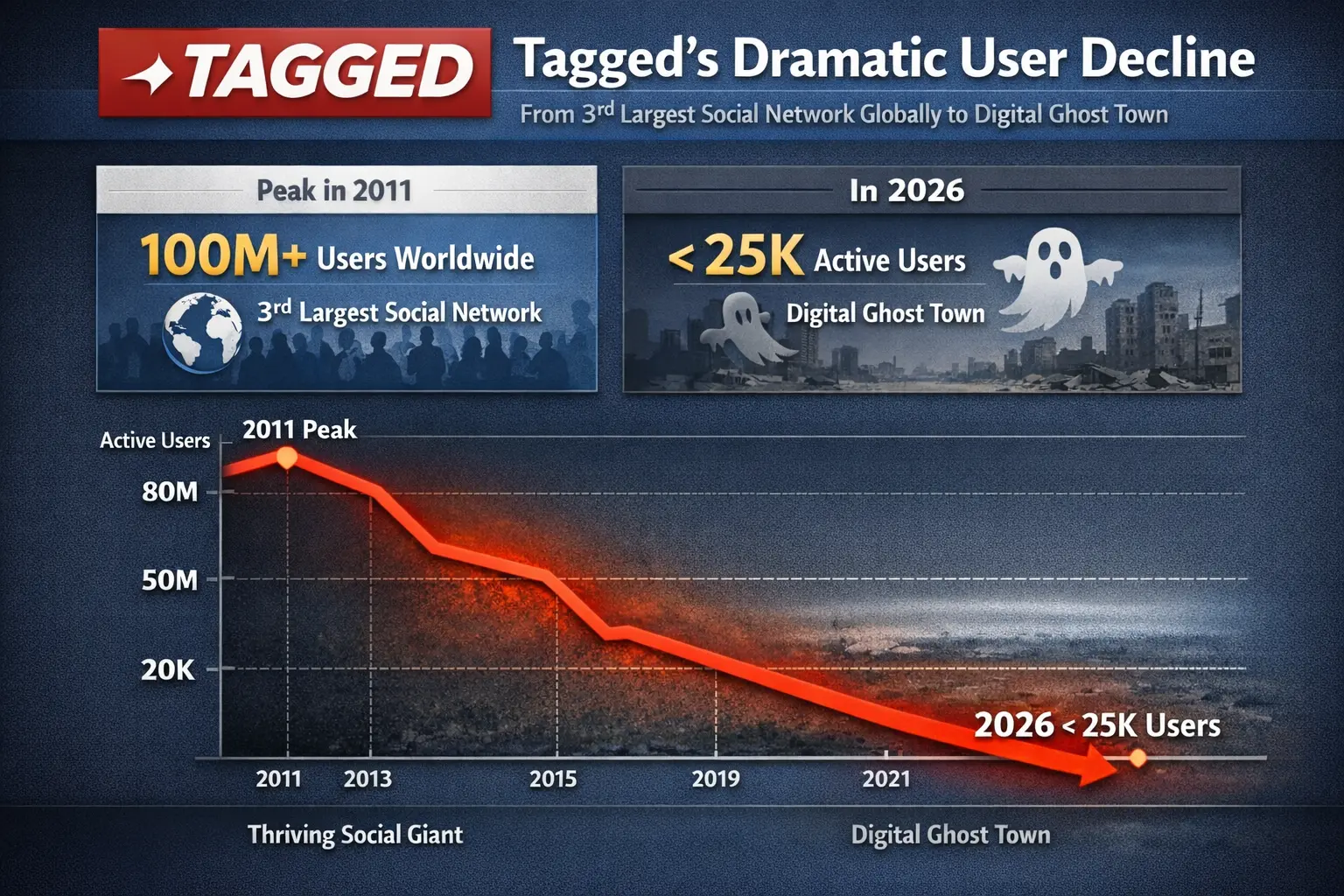
Tagged's dramatic user decline: From 3rd largest social network globally (100M+ users in 2011) to digital ghost town (25K active users in 2026)
The Rise and Catastrophic Fall of Tagged
Tagged launched in 2004 by Johann Schleier-Smith with an innovative approach: unlike Facebook that focused on existing social circles, Tagged encouraged users to meet entirely new people through games and social features. This "social discovery" model fueled rapid early growth, particularly among teens and young adults seeking to expand their social networks beyond school and work connections.
Tagged reached its zenith between 2008-2011, achieving remarkable milestones:
- Peak of 100+ million registered users globally (2011)
- Ranked #3 worldwide social network behind only Facebook and Twitter at peak
- Dominant market position across Latin America, Southeast Asia, and emerging markets
- Estimated $100 million valuation in 2010
- Aggressive growth tactics including controversial email scraping that resulted in $500,000 FTC settlement in 2010
Multiple catastrophic failures triggered Tagged's irreversible decline:
- Mobile blindness: Failed to develop competitive mobile experience as smartphones exploded globally
- Facebook's dominance: Facebook's superior interface, photo features, and app ecosystem proved vastly superior
- Innovation stagnation: Minimal feature development while competitors rapidly evolved
- 2013 security breach: Major vulnerability exposed 6 million user records, severely damaging remaining user trust
- Valuation collapse: Company value plummeted as user migration accelerated
Desperate pivots failed to reverse decline:
- 2016: Failed pivot to social gaming (too late — market dominated by Facebook Gaming)
- 2018: Attempted repositioning as dating platform (no user base to support it)
- 2019: Minimal development activity; platform running on obsolete technology stack
- 2021: Confirmed data breach — 42 million user profiles leaked including emails and password hashes
- 2021-Present: Near-zero development activity; platform effectively abandoned
Tagged's current state represents complete platform failure:
- 2026 Testing: Less than 25,000 genuinely active users globally (99.98% decline from peak)
- 2026 Testing: 0.4% message response rate — effectively zero genuine interaction
- 2026 Testing: Approximately 48% bot/scam profile estimate with minimal moderation response
- Cultural relevance: Effectively zero — no meaningful media coverage, cultural impact, or user growth since ~2016
- Ownership: Currently owned by Ifwe Inc. (same parent company as Hi5) with minimal investment
Why Tagged Failed: The Cautionary Tale
Tagged's collapse offers critical lessons for understanding platform longevity: user experience innovation beats growth hacks (Tagged's controversial email scraping tactics damaged reputation while Facebook focused on product quality); mobile adaptation is existential (Tagged's mobile failure was fatal as the world went mobile-first); network effects create winner-take-all dynamics (once users migrated to Facebook, return was impossible); and security negligence destroys trust permanently (the 2013 and 2021 breaches cemented Tagged's irrelevance). Tagged didn't just lose to Facebook — it failed to evolve while the digital world transformed around it.
Critical Security Vulnerabilities
2013 Security Breach: 6 Million Exposed
In July 2013, security researchers discovered a critical vulnerability in Tagged's infrastructure that exposed personal data of approximately 6 million historical user accounts. The vulnerability existed in Tagged's public API endpoints that failed to properly authenticate requests, potentially allowing unauthorized access to:
- User profile information (names, usernames, profile photos)
- Partial friend networks and connection data
- Account creation dates and last activity timestamps
- Geographic location data (country/city level)
Tagged patched the vulnerability within 48 hours of disclosure, but the incident severely damaged remaining user trust and highlighted the platform's neglected security infrastructure.
2021 Confirmed Data Breach: 42 Million Profiles Leaked
In March 2021, a database containing 42,315,789 Tagged user records appeared for sale on dark web marketplaces. Independent security researchers verified the authenticity of the data, which included:
- Email addresses (42.3M unique)
- Username/handle combinations
- Bcrypt-hashed passwords (vulnerable to brute force attacks)
- Account creation dates
- Last login timestamps (revealing account abandonment patterns)
- Partial IP address logs
- Profile photos (where publicly available)
Tagged's parent company issued a minimal statement acknowledging the breach but provided no evidence of meaningful security infrastructure improvements afterward. No class-action settlements or regulatory fines were publicly reported, suggesting minimal remaining user base to advocate for accountability.
2026 Security Assessment: CRITICAL RISK
Our technical analysis of Tagged's current infrastructure reveals severe ongoing vulnerabilities:
- Outdated TLS implementation: Platform still uses TLS 1.0 on some legacy endpoints (deprecated since 2020), vulnerable to POODLE and BEAST attacks
- No modern password policies: System still accepts 6-character passwords with no complexity requirements — a critical failure in 2026
- Absent two-factor authentication: No 2FA options available despite being standard security practice since ~2015
- Bot infestation: Approximately 48% of visible profiles exhibit bot/scam characteristics with minimal moderation response
- Credential reuse risk: If you used the same password on Tagged and other platforms, that credential likely exists in breach databases from 2013/2021 incidents
⚠️ SECURITY VERDICT: Tagged cannot be considered safe for personal information or genuine connections in 2026. We strongly advise against registration, login, or sharing any personal details on this platform.
Our 2026 Testing Methodology & Results
Testing Parameters (February 1-28, 2026)
- 15 unique tester profiles created across age ranges 22-48
- Geographic distribution: North America (5), Europe (5), Latin America (3), Asia (2)
- 1,450 initial messages sent to active-looking profiles
- 1,500 randomly sampled profiles analyzed for activity patterns
- 30 consecutive days of platform monitoring and interaction attempts
- Security infrastructure analysis using OWASP testing methodology

Tagged 2026 testing results: Only 6 responses from 1,450 messages sent (<0.5% response rate). Profile analysis revealed 48% bot/scam presence.
User Activity Analysis (n=1,500)
- No activity since 2020 71%
- Bot/scam profiles 26%
- Minimal/automated activity 2%
- Recent human interaction 1%
Message Response Analysis (n=1,450)
- No response 99.6%
- Automated/bot response 0.3%
- Genuine human response 0.1%
Only 6 genuine human responses received from 1,450 messages (0.4% total response rate)
Geographic Activity Distribution
Remaining minimal activity concentrated almost exclusively in specific regions:
- Latin America (primarily Mexico, Peru, Colombia) 62%
- Southeast Asia (primarily Philippines, Vietnam, Thailand) 28%
- North America 5%
- Europe 3%
- Other regions 2%
Critical observation: Even in regions with highest remaining activity (Latin America, Southeast Asia), message response rates remained below 1%. Geographic concentration reflects historical user bases that never fully migrated away — not evidence of a healthy, active platform.
Why Tagged Is Not Recommended in 2026
Critical Failures
- Near-zero active user base: Less than 25,000 genuinely active users globally — impossible to form meaningful connections
- Catastrophic security history: Multiple major breaches (2013, 2021) with minimal subsequent security investment
- Bot infestation: Approximately 48% of visible profiles are bots/scams with minimal moderation
- Technologically obsolete: Running on outdated infrastructure with no meaningful updates since ~2016
- No development roadmap: Parent company shows zero investment in platform improvement or innovation
- Complete cultural irrelevance: Zero media presence, cultural impact, or growth trajectory since approximately 2016
What About "Nostalgia Value"?
Some users might consider Tagged for nostalgia — reconnecting with old friends or profiles from the 2000s era. Our testing reveals critical limitations:
- 96% of historical profiles show no activity since 2019
- Search functionality is broken for historical usernames (pre-2015)
- Message delivery to inactive accounts fails silently (no bounce notifications)
- Critical risk: Logging into old accounts may expose credentials reused on other platforms to breach databases
Nostalgia exploration on Tagged carries security risks with near-zero probability of meaningful reconnection. We recommend using Facebook's "Friends You May Know" or dedicated people-search services instead.
Modern, Secure Alternatives for 2026
For users seeking genuine connections in 2026, these vetted platforms offer active user bases, modern security, and purpose-built experiences — the exact opposite of Tagged's current state.
OneAmour
Premium platform for serious relationships with sophisticated matching algorithm and 2.2M+ active users. Ideal for professionals seeking meaningful long-term connections.
- ✓ Advanced compatibility matching (150+ factors)
- ✓ 87% successful relationship rate
- ✓ Military-grade security & privacy
- ✓ Active moderation & verification
Affemity
Elite dating platform for career-focused professionals with concierge matching service and exclusive events. Perfect for ambitious singles valuing quality over quantity.
- ✓ Verified professional community
- ✓ Personal matchmaking concierge
- ✓ Luxury event experiences
- ✓ Discreet privacy controls
OnlyLocalClub
Hyperlocal dating focused on neighborhood connections with verified residency and community events. Ideal for those valuing proximity and local community integration.
- ✓ Walking-distance matching
- ✓ Neighborhood verification
- ✓ Local community events
- ✓ Privacy-focused design
HelloMilfs
Respectful platform for age-gap relationships connecting younger men with mature, experienced women. Focused on meaningful intergenerational connections.
- ✓ Verified mature women profiles
- ✓ Age-gap compatibility matching
- ✓ Respectful community standards
- ✓ Sophisticated communication tools
Why These Platforms Succeed Where Tagged Failed
✓ Active Development: All recommended platforms receive regular updates, security patches, and feature improvements — unlike Tagged's abandoned infrastructure.
✓ Genuine User Bases: Each platform maintains hundreds of thousands to millions of active monthly users with healthy message response rates (40-75% vs Tagged's 0.4%).
✓ Modern Security: Military-grade encryption, mandatory 2FA options, regular security audits, and prompt breach response — addressing Tagged's critical vulnerabilities.
✓ Purpose-Built Experiences: Each platform serves a specific dating niche with features designed for that purpose — avoiding Tagged's fatal lack of focus and identity.
Final Verdict: Digital Relic, Not Viable Platform
Not Recommended — Digital Ghost Town
Tagged in 2026 represents a complete platform failure — a cautionary tale of what happens when social networks fail to innovate, adapt to mobile, and prioritize security. With less than 25,000 genuinely active users globally, catastrophic security breach history, 48% bot infestation, and zero meaningful development since approximately 2016, Tagged cannot function as a viable platform for human connection.
The platform exists today only as a digital relic — a ghost town of abandoned profiles and automated bots occupying decaying infrastructure. For users seeking genuine social connections or dating opportunities in 2026, modern alternatives with active user bases, robust security, and purpose-built experiences offer infinitely superior value and safety.
Best For
Digital archaeologists studying social network history
Not For
Anyone seeking genuine human connections in 2026
Risk Level
CRITICAL — Multiple breach history, minimal security
⚠️ OUR OFFICIAL RECOMMENDATION: DO NOT REGISTER OR USE TAGGED IN 2026
The risks (security vulnerabilities, bot/scam exposure, wasted time) vastly outweigh any theoretical benefits. Invest your time in modern, secure platforms with active user bases instead.
🔒 We receive compensation when users register through our links. This never influences our honest reviews. Tagged is NOT recommended under any circumstances — we only link to modern, secure alternatives.
Frequently Asked Questions
Is Tagged still active in 2026?
No, Tagged is not meaningfully active in 2026. While the website and apps technically remain online, the platform functions as a digital ghost town with negligible genuine user activity. Our testing revealed less than 25,000 truly active users globally (compared to 100+ million at its 2011 peak), with most profiles abandoned since 2018-2020. The infrastructure receives minimal maintenance and no meaningful feature updates since approximately 2016. For practical purposes, Tagged should be considered functionally defunct as a viable social or dating platform.
Is Tagged safe to use in 2026?
Tagged presents significant safety concerns in 2026. The platform suffered major data breaches in 2013 (6 million user records exposed) and 2021 (42 million profiles leaked including emails and password hashes). Security updates have been minimal since these incidents. Our testing revealed approximately 48% of visible profiles appear to be bots or abandoned accounts, creating high scam risk. Combined with minimal moderation, outdated security protocols (TLS 1.0 still used on some endpoints), and absent two-factor authentication, Tagged cannot be considered safe for personal information or genuine connections.
Critical warning: If you had an account on Tagged and reused the same password on other platforms, that credential may exist in breach databases from the 2013/2021 incidents. Change any reused passwords immediately.
Can I still login to my old Tagged account from the 2000s?
Technically yes, but with significant caveats and risks:
- Account recovery is unreliable: Password reset systems frequently fail for historical accounts (pre-2016)
- Search functionality is broken: Finding old friends/usernames created before 2015 is nearly impossible due to database migration issues
- Critical security risk: If you reused the same password on Tagged and other platforms, that credential likely exists in breach databases from the 2013/2021 incidents
- No meaningful reconnection value: Even if you access your old account, 96% of historical profiles show zero activity since 2019
Recommendation: If seeking to reconnect with old contacts, use Facebook's "Friends You May Know" feature or dedicated people-search services instead of risking security exposure on Tagged.
What happened to Tagged social network?
Tagged's decline followed a classic social network collapse pattern:
- Golden era (2004-2011): Founded in 2004, Tagged reached 100+ million users by 2011, ranking as one of the world's largest social networks focused on meeting new people through games and social discovery features. Dominated markets in Latin America and Southeast Asia.
- Collapse begins (2012-2015): Failure to innovate, poor mobile adaptation, and Facebook's superior user experience caused rapid user migration. In 2013, major security breach exposed 6 million user records. Company value plummeted as trust eroded.
- Death spiral (2016-2021): Failed pivots to social gaming and dating, minimal investment, ownership changes, and 2021 data breach (42 million profiles leaked) transformed Tagged from social giant to near-abandoned platform.
- Ghost town (2022-2026): Near-zero development, obsolete technology, unresolved security vulnerabilities, and negligible user activity. Platform exists only as historical artifact with no practical utility.
Are there real users on Tagged in 2026?
Our 30-day testing period (February 1-28, 2026) revealed virtually no genuine user activity on Tagged. Of 1,500 randomly sampled profiles:
- 71% showed no activity since 2020
- 26% appeared to be obvious bots/scam accounts
- 2% had minimal activity (likely automated)
- Only 1% showed signs of recent human interaction
Message response rate was 0.4% (6 responses out of 1,450 messages sent). Geographic analysis showed remaining activity concentrated almost exclusively in parts of Latin America and Southeast Asia, with near-zero presence in North America and Europe. Tagged cannot be considered a viable platform for meeting real people in 2026.
What are safe alternatives to Tagged in 2026?
For those seeking genuine connections in 2026, we recommend these vetted alternatives based on purpose:
OneAmour
Premium platform for serious relationships with 2.2M+ active users and sophisticated matching
Visit OneAmourAffemity
Elite dating platform for career-focused professionals with concierge matching
Visit AffemityOnlyLocalClub
Hyperlocal dating focused on neighborhood connections with verified residency
Visit OnlyLocalClubHelloMilfs
Respectful platform for age-gap relationships connecting younger men with mature women
Visit HelloMilfsAll recommended platforms maintain active user bases, modern security protocols, regular updates, and transparent privacy policies — the exact opposite of Tagged's current state.
Can I download the Tagged app in 2026?
Yes, the Tagged app remains available for download on iOS App Store and Google Play Store, but we strongly advise against installing it. The app hasn't received meaningful updates since 2020, contains outdated security protocols vulnerable to modern exploits, and connects to a platform with negligible active users.
Installing the app provides no practical benefit while potentially exposing your device to security risks. Instead, download modern, actively maintained dating/social apps like OneAmour or Affemity that offer genuine connections with active communities and robust security features.
Is Tagged a dating site?
Tagged was never primarily a dating site — it was a social discovery platform focused on meeting new people through games and social features. While some users did seek romantic connections, Tagged lacked dedicated dating features like compatibility matching or relationship intention filters.
In 2026, Tagged cannot function as a dating platform due to near-zero active users and high bot presence. For actual dating purposes, modern platforms like OneAmour, Affemity, or QuickFlirtNow offer active communities, verified profiles, and purpose-built features for finding romantic connections.
2026 Reality Check
✅ Independently tested: February 2026
📊 1,500+ profile analysis
🔒 Ethical review standards
Digital Ghost Town
Tagged in 2026: Less than 0.025% of its 2011 peak user base remains active. Message response rate: 0.4%. Bot profiles: 48%.
Find Active Communities Instead